

A therapy superbill is an itemized, insurer-ready receipt clinicians hand to clients so they can file for out-of-network reimbursement themselves. It is not an invoice and not a progress note. It is a coded document built from CPT and ICD-10 data that gives an insurer everything needed to process a claim without you ever touching the payer portal.
If you're generating one this week, three things matter more than anything else. First, confirm your NPI, tax ID, and license number are current and match what's on file with NPPES, because a stale identifier is one of the fastest ways a superbill gets bounced. Second, record the correct CPT and ICD-10 codes on every service line, matched to what your documentation actually supports. Third, hand the client a signed PDF, not a screenshot or a scrawled note, so there's no question about authenticity when it reaches the payer.
- Verify NPI, EIN/SSN, and license number match your NPPES record exactly.
- Log accurate CPT and ICD-10 codes for each date of service, not a bundled monthly summary.
- Deliver a signed, single-page PDF the client can upload or mail without editing.
Small independent practices routinely write off 5 to 10 percent of collections to denied claims, and a sloppy superbill process is often part of that leak. Getting these three steps right up front saves hours of resubmission later.
Key Takeaways
A compliant therapy superbill requires accurate provider and patient identifiers, correctly matched CPT and ICD-10 codes per session line, and a signed PDF delivered securely to the client.
| Point | Details |
|---|---|
| Verify identifiers first | Confirm NPI, license number, and taxonomy code match your NPPES record before generating any superbill. |
| Match codes to documentation | Choose CPT codes based on documented session length and use specific ICD-10 codes over unspecified ones. |
| Sign and deliver securely | Provide a signed, single-page PDF through encrypted delivery or a HIPAA-compliant portal, never plain email. |
| Audit templates quarterly | Review your canonical superbill template every quarter to catch outdated fees or expired credentials. |
| Consider outsourcing at 10% denials | Axisbridgemedical offers HIPAA-certified denial recovery and billing support with EHR integration within about seven days. |
Table of Contents
- What Is a Therapy Superbill Used For, and When Should You Skip It?
- What Fields Must Appear on a Compliant Superbill?
- Which CPT and ICD-10 Codes Show Up Most on Therapy Superbills?
- How Do You Generate and Deliver a Superbill From Your EHR?
- How Long Does Superbill Reimbursement Usually Take?
- What Actually Causes Most Superbill Denials?
- When Does Outsourcing Billing Actually Pay Off?
- How Does Denial Recovery Actually Work Day to Day?
- How Do You Keep Superbills HIPAA-Compliant?
- What Does a Filled-In Superbill Example Look Like?
- What I've Learned Watching Small Practices Handle Superbills
- Get HIPAA-Certified Billing Support Built for Mental Health Practices
- Sources
What Is a Therapy Superbill Used For, and When Should You Skip It?
A superbill only makes sense in specific situations. If you're in-network with a client's insurer, you bill the payer directly, and a superbill has no role there. Superbills exist for out-of-network care, private-pay clients who still want a shot at partial reimbursement, and anyone using HSA or FSA funds who needs documentation for their account administrator.
For out-of-network therapy, the client pays you in full at time of service, then submits your superbill to their insurer for whatever reimbursement their plan allows. That could be 50 percent, 80 percent, or nothing at all depending on the client's out-of-network benefits, which is worth saying plainly the first time a client asks about it. For HSA or FSA situations, the superbill acts as proof of a qualified medical expense, and most account administrators want the same core fields an insurer would: diagnosis, procedure code, date, and amount.
The trade-offs run differently for you and your client. A superbill gives clients control over their own reimbursement process, but it also puts the burden of filing on them, and reimbursement timing becomes unpredictable once it leaves your hands. For your practice, superbills are lower administrative lift than submitting claims directly, since you're not chasing payer-specific forms or tracking adjudication status.
| Situation | Best approach |
|---|---|
| In-network client, standard plan | Submit claims directly to the payer |
| Out-of-network client wanting reimbursement | Generate a superbill for the client to submit |
| Private-pay client, no insurance filing planned | Simple receipt or superbill, mainly for HSA/FSA records |
| High denial rate or repeated coding errors | Consider a dedicated billing or denial-recovery service |
Use this as a quick filter: if you're spending more than an hour a week untangling denials or rebuilding superbills by hand, that's usually the signal to look at outsourcing rather than adding another spreadsheet.
What Fields Must Appear on a Compliant Superbill?
Insurers reject superbills for missing information more often than for anything else, so treat this as a checklist, not a suggestion. The required provider information includes your legal provider name, license type and number, 10-digit NPI, EIN or SSN depending on how you're structured, taxonomy code, and practice address.
Patient and insurer fields come next: full legal name matching the insurance card exactly, date of birth, member ID, group number, and the name of the primary policyholder if that's not the client themselves. A single mismatched letter between the client's legal name and their insurance card is a common, avoidable rejection.
Service line details are where most of the actual coding work happens. Each session needs its own line: date of service, CPT code, ICD-10 diagnosis code, place of service code, the fee charged, and the amount the client paid. Insurers expect one session per line; bundling three sessions into a single row to save space is a fast route to a denial. A provider signature, wet ink or electronic, closes out the document.
| Field category | Specific requirements |
|---|---|
| Provider identifiers | Legal name, license number, NPI, EIN/SSN, taxonomy code, practice address |
| Patient identifiers | Full legal name, DOB, member ID, group number, policyholder name |
| Service line data | Date, CPT code, ICD-10 code, place of service, fee, amount paid |
| Authentication | Provider signature (wet or electronic) |
- Double-check that patient name spelling matches their insurance card before printing.
- Never combine multiple sessions on one service line.
- Confirm taxonomy code matches your specialty exactly, since a generic code can trigger scrutiny.
Which CPT and ICD-10 Codes Show Up Most on Therapy Superbills?
Most outpatient therapy billing rotates through a small set of codes. 90791 covers the initial diagnostic evaluation. 90832 is for a 30-minute session, 90834 for 45 minutes, and 90837 for a full 60-minute session, chosen based on documented face-to-face time, not the time slot you scheduled. 90846 and 90847 cover family therapy without and with the client present, and 90853 is the code for group therapy.
For diagnosis codes, specificity protects you. F41.1 (generalized anxiety disorder), F32.1 (major depressive disorder, moderate), and F43.10 (PTSD) are far safer choices than reaching for an unspecified catch-all code just because it's faster to select. Payers increasingly flag vague ICD-10 codes for review, and a specific code that matches your clinical documentation holds up better under audit.
Telehealth adds a wrinkle. Place-of-service codes differ for virtual sessions, and some payers still require a modifier (commonly 95) to flag the visit as telehealth. Skipping that modifier when a session was actually conducted remotely is a quiet but frequent cause of claim delays.
Pro Tip: Keep a one-page cheat sheet taped inside your EHR workflow, not buried in a folder, listing your five most-used CPT codes next to the session length and documentation phrase that justifies each one.
How Do You Generate and Deliver a Superbill From Your EHR?
Building a clean superbill is a repeatable five-step process, whether you're using full EHR software or a standalone generator.
- Prefill your provider profile once: NPI, license, taxonomy, and practice address pulled directly from your NPPES record so nothing gets retyped incorrectly.
- Capture the client's insurance details at intake, including member ID and policyholder name, so the superbill template auto-populates correctly later.
- Log each session immediately with the matching CPT code and ICD-10 diagnosis, rather than batching notes at the end of the month.
- Export as a single-page PDF, either per session or as a monthly bundle if the client prefers one document per billing cycle.
- Sign the document, wet ink or e-signature, before it goes to the client.
Some browser-based generators build the PDF client-side, meaning the data never touches a server, which is worth considering if you're a solo practitioner handling occasional superbills without a full EHR system. For practices generating superbills regularly, though, a canonical template stored inside your EHR reduces drift, since a quarterly template audit catches outdated fee schedules or license renewals before they end up on a client's document.
Pro Tip: Set a recurring calendar reminder every three months to open your superbill template and check the fee schedule, license expiration, and NPI status. Stale templates are one of the sneakiest sources of denials.
How Long Does Superbill Reimbursement Usually Take?
Once you hand a client their superbill, the process moves out of your hands, but understanding the timeline helps you answer their questions. The client attaches the superbill to their insurer's out-of-network claim form, or uploads it directly through a member portal, along with any required member identifiers.
Most adjudication windows run 30 to 60 days, though incomplete submissions push that timeline out further while the insurer requests missing information. Clients should hold onto both the superbill and the resulting Explanation of Benefits, since discrepancies sometimes surface weeks after the initial submission.
You can shorten that cycle in small ways: hand over a genuinely clean PDF rather than something that needs editing, flag if the client's insurer is known for requiring its own claim form on top of the superbill, and log the date you gave the client their document. That log matters more than it sounds. Roughly 5 to 10 percent of collections at small practices get written off due to denials, and a documented delivery date is often the first thing you need if a client comes back asking why reimbursement stalled.
- Confirm the client knows whether their insurer needs a separate claim form alongside the superbill.
- Keep a simple log of delivery dates in case a client disputes timing later.
- Remind clients that adjudication delays usually mean missing fields, not a denial.
What Actually Causes Most Superbill Denials?
The list of denial triggers is short and repeats constantly across practices. Missing or incorrect provider identifiers, especially an expired or mistyped NPI, top the list, followed closely by patient name mismatches between the superbill and the insurance card on file. Incorrect CPT and ICD-10 pairings, bundled dates of service on a single line, missing signatures, and wrong place-of-service codes round out the usual suspects.
A practical weekly habit catches most of these before they reach a payer:
- Spot-check five recent superbills against the client's actual insurance card details.
- Confirm your NPPES listing hasn't lapsed or changed since your last audit.
- Cross-reference a sample of CPT codes against session notes to confirm documented time matches the billed code.
- Verify every service line carries a single date, not a bundled range.
When a denial letter cites "invalid provider identifier," check your NPPES record character by character before resubmitting. When it cites a diagnosis and procedure mismatch, pull the session note and confirm the ICD-10 code reflects what was actually documented that day, not a default code copied from the prior visit.
Pro Tip: Resubmissions move faster when you attach a short cover note explaining exactly what was corrected. Payers process a flagged, specific correction faster than a resubmission that looks identical to the original.
When Does Outsourcing Billing Actually Pay Off?
Three numbers tell you whether it's time to bring in help: your claim denial percentage, your accounts receivable days, and how many hours your staff spends on appeals each month. If denials sit above 10 percent, AR days keep climbing past 45, or the same coding mistake shows up repeatedly, in-house handling has probably hit its ceiling.

The math is straightforward for a typical small practice. If denials are eating 5 to 10 percent of collections, recovering even half of that through dedicated denial recovery meaningfully changes monthly cash flow, often more than the cost of a billing service itself.
| Decision factor | Signal it's time to outsource |
|---|---|
| Denial rate | Above 10% of submitted claims |
| AR days | Consistently over 45 days |
| Staff time on appeals | More than a few hours weekly |
| Coding errors | Same mistake recurring across months |
When evaluating a vendor, expect a few concrete things: a defined EHR integration timeline, typically within about seven days for a turnkey setup, a signed Business Associate Agreement before any data changes hands, a clear reporting cadence so you can see denial trends, and transparent pricing, whether that's a flat monthly fee or a percentage of collections.
How Does Denial Recovery Actually Work Day to Day?
A denial-recovery workflow follows a consistent pattern regardless of who runs it. First, someone audits the batch of denied claims to identify what actually went wrong, whether it's a coding mismatch, a missing modifier, or an eligibility issue that should've been caught at intake. Second, that audit gets sorted into correctable patterns rather than treated as one-off problems, since the same root cause is often behind a dozen denials at once. Third, appeals or resubmissions go out with the specific correction documented. Fourth, outcomes get tracked and recovered payments posted back to the practice's ledger.
Axisbridgemedical builds its service around this exact loop for independent mental health practices. Its team is HIPAA-certified, focuses specifically on denial recovery rather than general billing, and advertises EHR integration within about seven days, which matters if you don't want a months-long onboarding eating into the revenue you're trying to recover.
Small mental health practices routinely write off 5 to 10 percent of collections to denied claims. Recovering even a portion of that changes what cash flow looks like at the end of the month, without adding a full-time hire to your payroll.
- Audit denied claims to find recurring patterns before resubmitting anything.
- Track outcomes so recovered payments get posted correctly to the practice ledger.
- Prioritize a vendor with specialty experience in behavioral health coding, since generic medical billing knowledge doesn't always translate.
How Do You Keep Superbills HIPAA-Compliant?
Every superbill contains protected health information, which means storage and delivery choices carry real compliance weight. Send superbills through encrypted PDF delivery or a HIPAA-compliant patient portal, never as an unsecured email attachment.
If you're using any outside vendor or software to generate or store superbills, require a signed BAA before sharing any client data, and confirm the vendor's HIPAA certification directly rather than taking a sales page's word for it. Role-based access controls matter too: not everyone on staff needs the ability to view or export financial and diagnostic data together.
- Use encrypted delivery or a secure portal, never standard email, for any document containing PHI.
- Confirm a signed BAA exists before a vendor touches client billing data.
- Restrict superbill access to staff who genuinely need it, and keep an audit log of who accessed what.
Pro Tip: Set a recurring reminder to review your access logs quarterly, not just when something looks wrong. Most breaches get discovered months after they happen.
What Does a Filled-In Superbill Example Look Like?
A minimal superbill template needs surprisingly few fields to be compliant, but every one of them has to be right. Below is what a single-session line and a monthly aggregate might look like once filled in.
Format it as a single-page PDF, PDF/A where your software supports it for long-term archival stability, and name the file consistently, something like "clientlastname_030426," so tracking down a specific document later doesn't turn into a search project.
- Keep provider fields identical across every superbill you generate.
- Use one line per date of service, never a combined range.
- Save filed copies using a consistent naming convention tied to date of service.
What I've Learned Watching Small Practices Handle Superbills
The clinicians who struggle least with superbills aren't the ones with the fanciest software. They're the ones who treat the template itself as a living document, not a file created once and forgotten. Every quarter, something changes: a fee schedule, a license renewal, a new taxonomy code, and if the template doesn't get updated, that drift shows up as a denial three months later with no obvious cause.
The bigger mistake I see is treating superbill generation as separate from clinical documentation, when really they need to move together. If your session note says 45 minutes of individual therapy but your superbill lists 90837, that's a 60-minute code, and that gap is exactly what audits are built to catch. The fix isn't more paperwork. It's making sure whoever fills out the superbill, whether that's you or a delegated staff member, is pulling directly from the same note you wrote, not reconstructing it from memory at the end of the week.
Delegating superbill generation makes sense once your practice grows past a handful of clients, but only if the person doing it has a clear, current template and understands why the fields exist, not just how to fill them in.
Get HIPAA-Certified Billing Support Built for Mental Health Practices
Axisbridgemedical is the alternative to hiring and training an in-house biller for practices in Texas, Florida, and Georgia losing revenue to denied claims. Instead of carrying the salary, benefits, and turnover risk of a full-time billing employee, you get a dedicated, HIPAA-certified team focused specifically on denial recovery, eligibility verification, claims submission, and accounts receivable management for behavioral health.
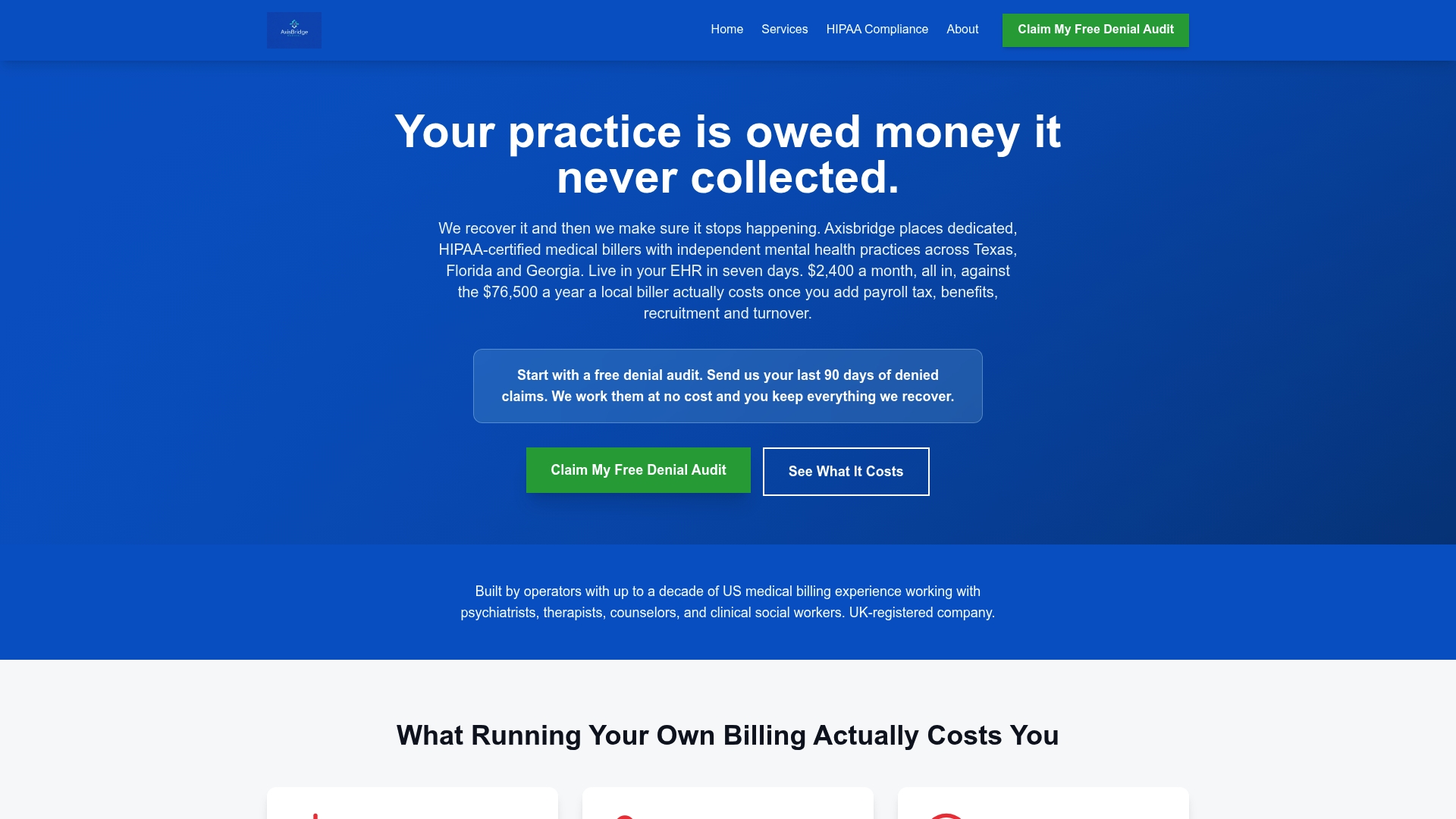
Onboarding is built to move fast: Axisbridgemedical typically completes EHR integration within seven days, and every engagement starts with a signed BAA and a review of its HIPAA compliance and security practices before any client data changes hands. If your practice is writing off 5 to 10 percent of collections to denials, that's revenue worth reclaiming rather than absorbing quietly every quarter.
If superbills and denial rework are eating into hours you'd rather spend with clients, request a denial-recovery assessment through Axisbridgemedical and see what a seven-day integration actually looks like for your practice.
Sources
Clinicians building or updating a superbill workflow can lean on a few specific resources rather than starting from scratch.
- Free Superbill Template for Therapists (2026) | Superbilled
- Free Superbill Generator for Therapists | HIPAAtherapy
This article is general information, not a substitute for advice from a qualified financial advisor. Consult a qualified financial professional about your own circumstances before acting on anything here.