

Bill CPT 90853 per participating patient, link a medically necessary ICD-10 diagnosis to each claim, and document individualized participation for every group member. That is the core rule. Before you submit a single claim, run three checks: confirm the payer covers group psychotherapy (not all do, and many cap session frequency), verify each patient has an individualized clinical note tied to their treatment plan, and confirm the correct modifier and place-of-service code for telehealth or any same-day service.
A quick-reference claim line looks like this: CPT 90853 | ICD-10 (e.g., F33.1) | Rendering Provider NPI | POS 11 (office) or POS 02 (telehealth) | 1 unit per patient.
Three actions to take before your next group session:
- Call or portal-check each payer for group therapy coverage, frequency limits, and group-size caps
- Build or audit your EHR note template to capture individualized participation, not a shared group narrative
- Confirm every rendering provider's NPI and taxonomy code are active and credentialed with each payer
According to operational RCM guidance, practices that treat group therapy billing like individual therapy workflows predictably leak revenue through denials that are entirely preventable with upstream process controls.
Key Takeaways
Accurate group therapy billing requires one claim per patient, individualized documentation, and payer-specific verification before every session.
| Point | Details |
|---|---|
| Bill per patient, not per group | Submit one CPT 90853 claim line per participant per session, each with its own ICD-10 and individualized note. |
| Individualized documentation is non-negotiable | Each patient's note must show specific participation, clinical response, and treatment plan linkage, not a shared group narrative. |
| Payer rules vary significantly | Confirm group-size caps, frequency limits, telehealth modifiers, and PHP G-code requirements with each payer before billing. |
| Modifiers require documentation support | Apply +90785, modifier 95, or modifier 25 only when the clinical record explicitly supports the complexity or service distinction for that patient. |
| Axisbridgemedical recovers denied claims | For practices in Texas, Florida, and Georgia, Axisbridgemedical provides dedicated mental health billing, documentation audits, and denial recovery with EHR integration in seven days. |
Table of Contents
- What CPT 90853 actually covers and what it doesn't
- Session length, group size, and how units work
- Which providers can bill 90853 and what credentialing requires
- Codes, modifiers, and add-ons you need to know
- What documentation must show for each group participant
- Medicare and Medicaid rules that change how you bill
- Why group therapy claims get denied and how to fix them
- Sample claim lines and a submission workflow that works
- How to find accurate reimbursement rates for CPT 90853
- How Axisbridgemedical handles group therapy claims for mental health practices
- The part of group therapy billing most practices get wrong
- Sources
What CPT 90853 actually covers and what it doesn't
CPT 90853 describes group psychotherapy for multiple unrelated individuals conducted by a physician or other qualified healthcare professional. It is billed once per patient per session, not once per group. The clinical intent matters: the service must constitute active psychotherapy, meaning the clinician is providing therapeutic interventions directed at each participant's diagnosed mental health condition.
What falls outside 90853's scope is worth knowing precisely:
- Support groups (peer-led or facilitated without individualized psychotherapy) are generally not reimbursable under CPT 90853 because they lack the individualized, medically necessary psychotherapy elements payers require
- Recreational or socialization activities do not meet the clinical threshold regardless of who runs them
- Multi-family group therapy uses CPT 90849 (multiple-family group psychotherapy), a distinct code
- Family therapy (with or without the patient present) uses 90847 or 90846, not 90853
- Psychoeducation groups occupy a gray zone; payer policies vary, and some carriers require prior authorization or deny them outright
The AMA CPT definition and CMS guidance both reinforce that the group must consist of unrelated individuals receiving active psychotherapy. Payers sometimes impose additional restrictions beyond the CPT definition, including proprietary codes or prior authorization requirements for specific diagnoses. Always check the payer's behavioral health policy, not just the CPT manual.
Session length, group size, and how units work
CPT 90853 is not a time-based code. You bill one unit per patient per session, regardless of whether the session runs 45 minutes or 90 minutes. That said, payer expectations on minimum duration are real. Many commercial payers and Medicare contractors expect sessions to run at least 45 minutes, and CodingAhead's 2025–2026 billing guidelines note this as a common benchmark. Sessions shorter than 45 minutes risk denial or downcoding on audit.
Group size guidance is less standardized than many billers assume. A clinically common range is 6–10 participants. Medicare guidance references groups of approximately a dozen participants as a workable ceiling, though this is not a hard federal rule. Some payers set their own caps, typically 8–12, and will deny claims for sessions that exceed those limits. Confirm the cap in each payer's behavioral health policy before scheduling.
Partial attendance is where documentation gets complicated. If a patient arrives late or leaves early, your practice needs a written policy on minimum attendance thresholds before billing. Whatever threshold you choose, document the actual time in and time out in the individual note.
Pro Tip: Set up your EHR to capture arrival and departure times as discrete fields, not just a free-text note. That data becomes your defense if a payer audits attendance.
- Bill 1 unit of 90853 per patient per session (not per group)
- Confirm minimum session duration with each payer (45 minutes is a common floor)
- Document actual attendance time for each participant, especially for partial attendance
- Know each payer's group-size cap before scheduling
Which providers can bill 90853 and what credentialing requires
The provider types who typically may bill CPT 90853 include psychiatrists, psychologists (PhD/PsyD), licensed clinical social workers (LCSWs), licensed professional counselors (LPCs), and licensed marriage and family therapists (LMFTs). The operative word is "typically." Each payer maintains its own credentialing requirements, and a provider type covered by one commercial plan may be excluded by another or by a specific state Medicaid program.
Credentialing checklist before billing group therapy:
- Confirm the rendering provider has an active individual NPI (Type 1) and the correct taxonomy code for their license type
- Verify the provider is credentialed and contracted with each payer whose members are in the group
- Check that the billing NPI (Type 2, group practice) is also enrolled with each payer
- Confirm telehealth practice allowances are on file if any sessions are delivered remotely
- Track credentialing expiration dates; a lapsed credential is an instant denial trigger
- Validate that the rendering provider's license is active in the state where the patient is located (critical for telehealth)
One operational detail that causes unnecessary denials: the rendering provider on the claim must match the credentialed provider exactly. If a supervising psychiatrist oversees an LCSW-led group, the billing arrangement depends entirely on the payer's supervision and incident-to rules. Some payers allow incident-to billing for group therapy; others require the credentialed clinician to be present throughout. Get this in writing from each payer.
Codes, modifiers, and add-ons you need to know
The primary codes for group and family therapy services are:
- 90853: Group psychotherapy (unrelated individuals) — the workhorse code for most outpatient group programs
- 90849: Multiple-family group psychotherapy — billed when families (not unrelated individuals) participate together
- 90847: Family psychotherapy with patient present; 90846 without patient present
- G0410 / G0411: Medicare uses these G-codes for group psychotherapy in partial hospitalization programs, not CPT 90853 — a critical distinction for PHP billing
Add-on code +90785 (interactive complexity) can be appended to 90853 per patient when communication or behavioral factors materially increase the clinician's effort. Examples include managing a patient's aggressive or disruptive behavior during the session, working through a legally mandated third party, or navigating a patient with communication barriers. CMS guidance is explicit: the documentation must demonstrate the complexity for each individual patient on whose claim you append +90785. You cannot apply it group-wide.
Modifiers to know:
- 95 or GT: Synchronous telehealth delivery. Verify which modifier your payer accepts; Medicare uses 95, some commercial payers still use GT
- Modifier 25: Appended to a same-day E/M when the E/M is significant and separately identifiable from the psychotherapy service. CMS guidance requires the E/M and psychotherapy to be distinct services with separate documentation
- Modifier 59 (or X{EPSU} variants): Used to distinguish separate procedural services when Correct Coding Initiative (CCI) edits would otherwise bundle them
Pro Tip: Run a CCI edit check in your clearinghouse or billing software before submitting any claim that pairs 90853 with another psychotherapy or E/M code on the same date. An unbundling denial is far harder to appeal than a front-end edit catch.
What documentation must show for each group participant
A group attendance sheet is not a medical record. Every patient in the group needs an individualized note that stands on its own as evidence of medically necessary psychotherapy. Payers and Medicare auditors look for these specific elements in each patient's record:
- Diagnosis: Active ICD-10 code linked to the treatment plan
- Treatment plan linkage: The session's therapeutic objective tied to a goal in the patient's current plan
- Individualized participation: A specific description of how this patient engaged, responded, or progressed — not a copy-paste of the group topic
- Clinical response: Observable behavior, affect, or verbal content that demonstrates the patient's response to the intervention
- Therapeutic interventions used: Named techniques (e.g., cognitive restructuring, motivational interviewing, psychoeducation) applied during the session
- Session logistics: Date, start and end time, number of participants, provider name and credentials, provider signature
A note template that prompts individualized entries might look like this:
"[Patient] participated in group psychotherapy addressing [goal from treatment plan]. During the session, [patient] [specific behavior/statement]. The clinician utilized [intervention]. Patient's response was [clinical observation]. Plan: [next step]."
Pro Tip: EHR templates are a double-edged tool. A well-built template speeds documentation without cloning. A poorly built one produces identical notes across patients — the single fastest way to trigger a medical necessity denial or a recoupment audit. Build templates that require the clinician to fill in patient-specific fields before the note can be signed.
The archived CMS LCD guidance reinforces that documentation must support medical necessity for each individual, not for the group as a whole.
| Documentation Element | What to Include | Common Failure |
|---|---|---|
| Diagnosis | Active ICD-10 linked to treatment plan | Generic or outdated code |
| Participation | Patient-specific behavior or statement | Copy-pasted group narrative |
| Intervention | Named technique applied | Vague "group therapy provided" |
| Clinical response | Observable affect or progress | Absent or identical across notes |
| Provider signature | Credentials and date | Missing or unsigned |
Medicare and Medicaid rules that change how you bill
Medicare covers group psychotherapy under CPT 90853 for outpatient psychiatric services, but the rules around bundling, place of service, and program type create real complexity. CMS guidance is clear that when a psychiatrist or other qualified provider delivers both an E/M and psychotherapy on the same date, the services must be significant and separately identifiable to bill both. The E/M requires modifier 25 and its own documentation.
For partial hospitalization programs, stop before billing 90853. Medicare requires G0410 (group psychotherapy, less than or equal to 45 minutes) or G0411 (greater than 45 minutes) for PHP group encounters. Billing 90853 in a PHP setting is a coding error that will trigger denial and potentially a compliance flag.
Local Coverage Determinations (LCDs) add another layer. Medicare Administrative Contractors publish LCDs that can restrict covered diagnoses, require specific documentation elements, or impose frequency limits beyond the national policy. Your MAC's LCD for psychiatric services is not optional reading.
State Medicaid programs vary significantly. Common variations include:
- Unit caps per day or per week for group psychotherapy
- Prior authorization requirements for ongoing group treatment
- Coverage exclusions for specific provider types (some state Medicaid plans do not cover LPC-billed group therapy)
- Proprietary billing codes that replace CPT 90853 entirely
- Telehealth parity rules that differ from Medicare's
Check each state Medicaid fee schedule and billing manual directly. Texas, Florida, and Georgia each maintain their own behavioral health billing guidelines that may differ from CMS national policy.
Why group therapy claims get denied and how to fix them
Denials for group therapy services cluster around a predictable set of root causes. Knowing them in advance means you can prevent most of them before submission.
Top denial reasons and corrective actions:
- Non-covered service (support group billed as 90853): The fix is clinical, not billing. Confirm the session meets the psychotherapy standard before billing. If it doesn't, don't bill it.
- Missing individualized documentation: Pull the note, add the patient-specific participation and clinical response, and resubmit with a corrected claim or appeal letter citing the updated documentation.
- Exceeding payer group-size caps: Check the payer policy before scheduling. If the denial is already in, appeal with the payer's own policy language and the session attendance record.
- Incorrect modifier or POS for telehealth: Resubmit with the correct modifier (95 vs. GT) and POS code (02 for telehealth). Include a brief cover letter explaining the correction.
- Duplicate edit when individual and group therapy are billed on the same date: Append modifier 59 (or the appropriate X-modifier) to distinguish the services, and ensure both notes are in the record before resubmitting.
- Credentialing mismatch: The rendering provider on the claim doesn't match the credentialed provider. Correct the claim and verify the provider's enrollment status with the payer.
Appeal checklist:
- Copy of the individualized clinical note for the denied patient
- Relevant payer policy language (behavioral health benefit document)
- Attendance log for the session
- Prior authorization number if applicable
- Cover letter citing the specific denial reason and the corrective evidence
When denials involve documentation disputes or payer policy interpretation, and internal appeals have failed twice, escalate to a denial recovery specialist. Repeated denials on the same root cause signal a systemic process gap, not a one-off error.
Sample claim lines and a submission workflow that works
A clean CMS-1500 line for CPT 90853 looks like this (per patient):
| Field | Value |
|---|---|
| Box Diagnosis | F33.1 (or patient-specific ICD-10) |
| Box CPT Code | 90853 |
| Box Diagnosis Pointer | A (linking to Diagnosis) |
| Box Charges | Practice fee schedule amount |
| Box Units | 1 |
| Box POS | 11 (office) or 02 (telehealth) |
| Box Rendering NPI | Individual provider NPI |
| Box 33 (Billing NPI) | Group practice NPI |
For a telehealth session with interactive complexity, add modifier 95 and +90785 on a separate line, with documentation supporting the complexity for that specific patient.
Recommended submission workflow:
- Benefits verification: Confirm group therapy coverage, frequency limits, and group-size caps for each patient before the session
- Pre-session: Confirm all rendering providers are credentialed and active with each patient's payer
- At time of service: Capture individualized notes for each participant before end of day; do not batch-document the next morning
- Charge capture: Enter one claim line per patient, not one per group; apply modifiers only where documentation supports them
- Clearinghouse scrub: Run CCI edits and eligibility checks before transmission
- Denial monitoring: Review remittance advice within 48 hours of posting; flag denials by root cause for trend analysis
- Payment posting: Post EOBs per patient, not per session, to maintain accurate AR by individual
Operational RCM guidance recommends building a payer-specific group therapy coding grid that maps each payer's rules, caps, and modifier requirements in one reference document. That grid becomes the front-line defense against upstream errors.
How to find accurate reimbursement rates for CPT 90853
The CMS Physician Fee Schedule search tool is the authoritative source for Medicare payment amounts. Enter CPT 90853, select your MAC locality, and compare the non-facility rate (for office-based sessions) against the facility rate (for hospital outpatient or community mental health center settings). The non-facility rate is almost always higher because it includes practice expense reimbursement.
MedReveal's 2026 national non-facility Medicare rate data shows meaningful geographic variability after Geographic Practice Cost Index (GPCI) adjustments. A practice in a high-cost urban market will receive a materially different payment than one in a rural area, even under the same national fee schedule. Check your specific MAC locality, not just the national unadjusted rate.
Factors that change your actual reimbursement:
- Non-facility vs. facility site of service (non-facility pays more for 90853 in most localities)
- Telehealth parity laws: some states require commercial payers to reimburse telehealth at the same rate as in-person; others do not
- Interactive complexity add-on (+90785) adds a separate payment line per patient where documented
- Commercial payer contracts: most commercial rates are expressed as a percentage of Medicare (often 100–130% for behavioral health), but this varies by contract and region
- State Medicaid fee schedules are set independently and may be significantly below Medicare rates
Pro Tip: Build a payer-rate lookup grid for your recurring group programs. List each payer, the contracted rate for 90853, the telehealth rate, the +90785 add-on rate, and the effective date of the contract. Review it quarterly. A rate that was accurate 18 months ago may have changed at contract renewal without a direct notice to your billing team.
How Axisbridgemedical handles group therapy claims for mental health practices
Independent mental health practices running group programs face a specific billing problem: the per-patient, per-session structure of CPT 90853 multiplies both the documentation burden and the denial exposure compared to individual therapy. Axisbridgemedical is built for exactly this operational profile.
For practices in Texas, Florida, and Georgia, Axisbridgemedical provides payer benefits verification before each group session, credentialing and enrollment management to keep rendering providers active across payers, and individualized documentation audits that catch note deficiencies before claims go out the door. When denials do occur, the denial recovery sprint targets the root cause, assembles the appeal evidence, and resubmits with the documentation that payers actually need.

EHR integration takes seven days, meaning your existing workflow doesn't get rebuilt from scratch.
Pro Tip: Before onboarding any billing service, prepare a provider roster with NPI and taxonomy codes, a sample set of group therapy notes, and copies of your current payer contracts. That package cuts the setup timeline significantly and lets the billing team identify payer-specific issues before the first claim goes out.

Axisbridgemedical's HIPAA-certified billing team handles PHI with the same compliance standards your practice is already required to meet. If your group therapy claims are generating denials you can't resolve internally, or if you're building a new group program and want a clean billing foundation from day one, contact Axisbridgemedical to discuss a denial recovery sprint or dedicated billing support.
The part of group therapy billing most practices get wrong
The conventional advice on group therapy billing focuses almost entirely on the code: use 90853, bill per patient, done. That framing misses where the actual revenue loss happens.
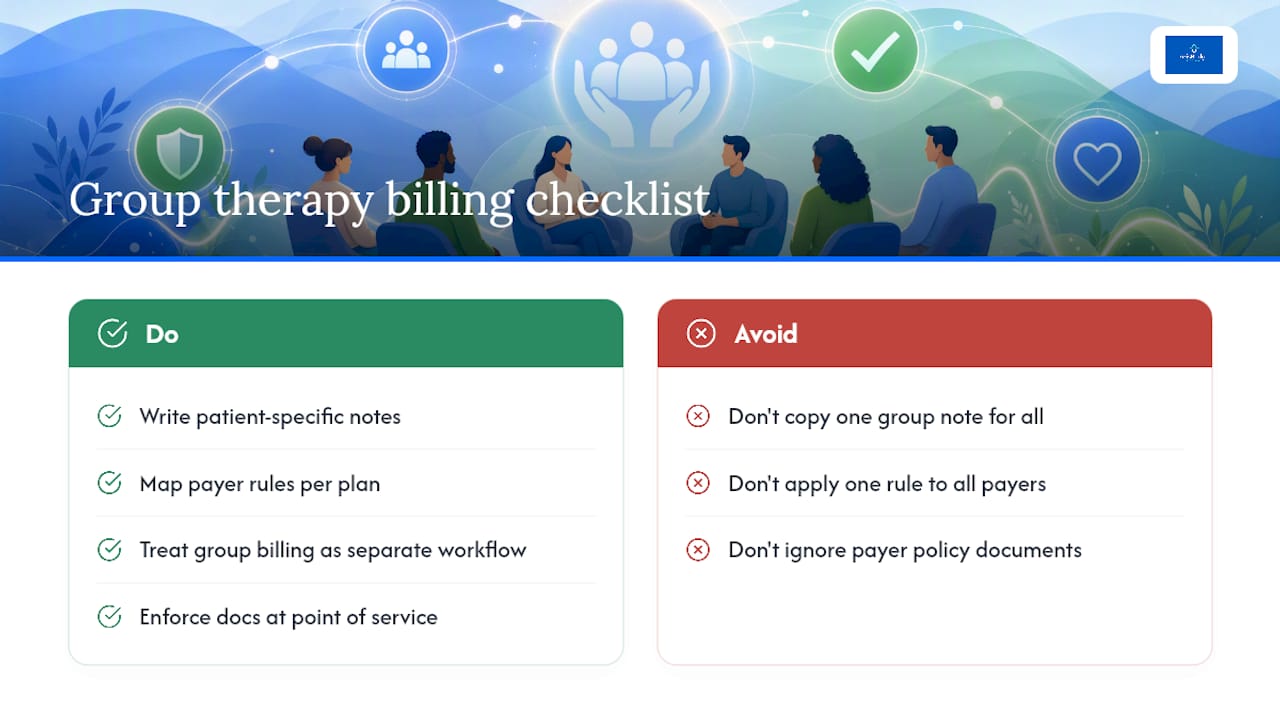
The real problem is upstream. Most denials for group therapy claims don't fail at the code level. They fail because the documentation was written for the group, not for the patient. A clinician who runs a 90-minute DBT group with eight participants and writes one shared note, then copies it eight times with different names, has not created eight medical records. They've created one record with eight names on it. Payers know this. Auditors know this. And when a recoupment request arrives, that practice has no defense.
The second underappreciated issue is payer variability. Practices that run the same group program for patients across three or four different payers often apply one billing rule to all of them. That works until it doesn't. One payer caps the group at eight participants. Another requires prior authorization after the sixth session. A third doesn't cover LPC-billed group therapy at all. None of these rules are hidden. They're in the behavioral health policy documents that most practices never read.
What actually works is treating group therapy billing as its own workflow, separate from individual therapy, with payer-specific rules mapped in advance and documentation standards enforced at the point of service. The practices that get this right don't have fewer denials because they're lucky. They have fewer denials because someone built the process correctly before the first claim went out.
This article is general information, not a substitute for advice from a qualified financial advisor. Consult a qualified financial professional about your own circumstances before acting on anything here.
Sources
- CMS Medicare Coverage Database Article 57480
- Downloads
- CPT 90853: Group Psychotherapy Billing and Guidelines (2025–2026) - Coding Ahead LLC
- CPT 90853 — Group Psychotherapy Reimbursement Rates | MedReveal